
Blog
A SPACE IN TIME – CHAPTER 4

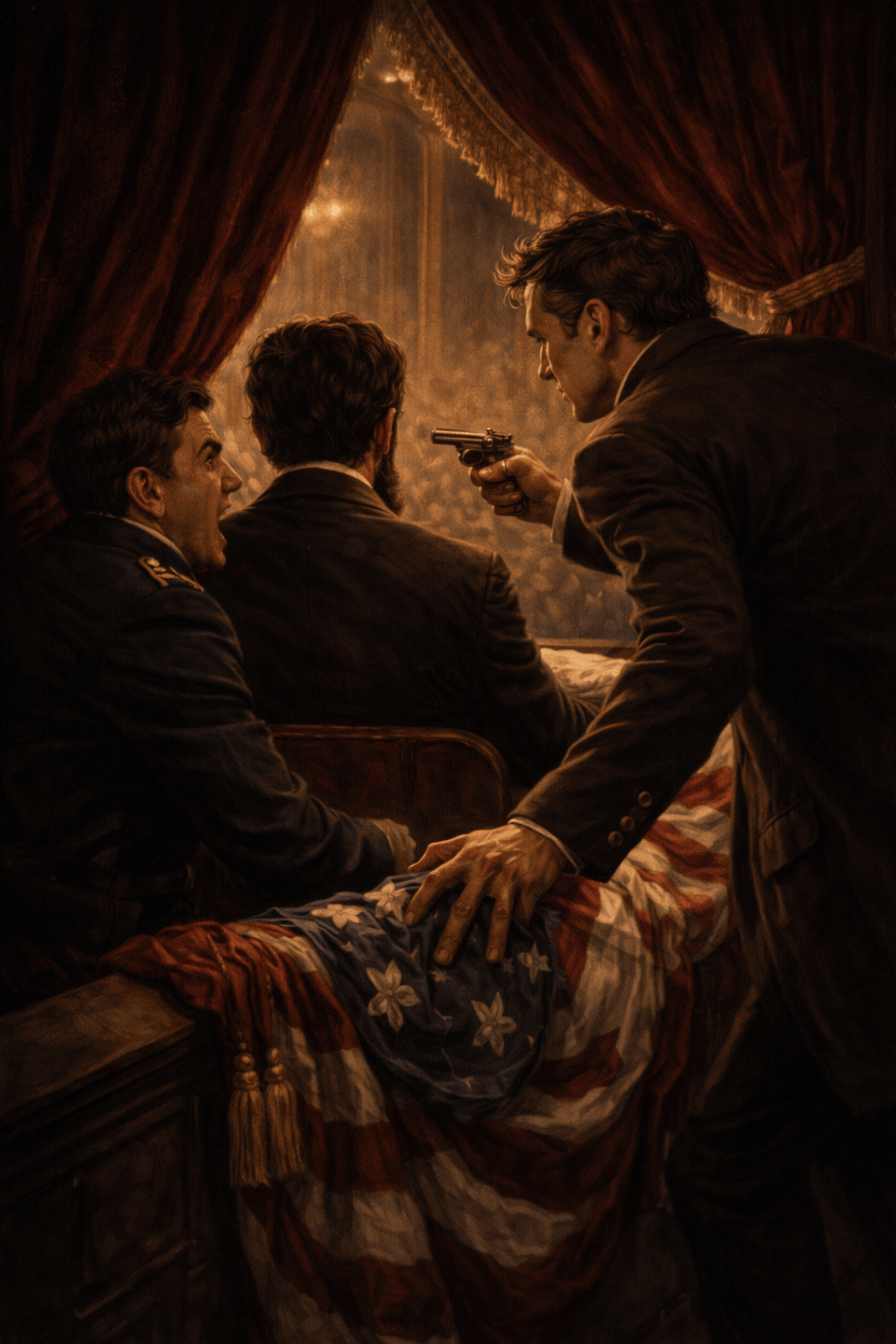
President Lincoln laughed heartily at Hawk’s line. Mary glanced at him and smiled. It was so good to hear him laugh again. He had not laughed in months.
Behind them, the door to the Presidential Box opened quietly. John Wilkes Booth stepped inside and raised his derringer, aiming directly at the back of Lincoln’s head.
At that exact instant, Major Henry Rathbone, seated slightly behind and to Lincoln’s right, sensed movement and turned. He saw Booth’s arm extended, the pistol leveled at the President.
Without hesitation, Rathbone lunged forward.
The gun fired. Rathbone’s shoulder struck Booth’s arm just as the trigger was pulled. The shot went wild, striking the ceiling above them with a sharp crack. A cloud of white smoke erupted from the pistol, momentarily obscuring Booth from view.
Booth staggered backward, stunned, but not defeated. In one swift motion, he dropped the useless pistol and drew his knife. He thrust forward.
Rathbone saw the blade coming and raised his arms to defend himself. The knife slashed deeply along his left arm, tearing through cloth and flesh from elbow to shoulder. Pain shot through him, but with his right hand, he seized Booth’s coat and held fast.
Booth twisted violently, wrenching himself free. He leapt onto the railing and sprang toward the stage twelve feet below.
As he jumped, something caught—perhaps Rathbone’s grasp, perhaps his spur tangled in the draped Treasury flag. Booth lost his balance and landed awkwardly, collapsing onto the stage. He staggered to his feet, his leg buckling beneath him. He raised his dagger and cried out “Sic semper tyrannis!”
Above, Rathbone staggered forward, blood streaming down his arm. “Stop that man!” he shouted. “Stop him!”
But confusion had seized the theatre. The audience, uncertain whether the violence
was part of the play, hesitated. Booth limped across the stage and disappeared behind the curtain, escaping into the darkness beyond.
Rathbone stood trembling, his arm slick with blood, his heart pounding. Though he had saved the President, he knew how close he had come to failure. It was a burden he would carry for the rest of his life.
Lincoln had fallen forward at the sound of the gunshot. Mary clutched him desperately.
“Abe!” she cried.
Lincoln looked up, startled but unharmed.
“My dear,” he said gently, “I believe I am quite all right. If you would kindly release me, I believe I shall stand.”
Mary withdrew her hands, her face pale. Lincoln rose slowly and looked up at the bullet hole in the ceiling.
“I believe,” he said thoughtfully, “that fellow has improved the ventilation in this box.”
He resumed his seat in the rocker to steady himself and turned to the Major, whose arm was now being attended by his fiancée, Clara Harris.
“Well, Major,” Lincoln said, studying the wound, “it appears you have had the more unpleasant evening than I. I am in your debt for saving my life tonight. Thank you, Henry.”
Lincoln’s tall frame came into view above the railing. A murmur spread through the theatre. Then applause. It began hesitantly, uncertainly but then swelled into a thunderous ovation.
Lincoln stood, flushed with embarrassment, and bowed his head slightly in acknowledgment. He had never cared for such displays. He resumed his seat quickly, hoping to draw as little attention as possible.
He glanced again at Rathbone as a doctor from the audience dressed the wound.
“Major,” Lincoln said dryly, “I fear you have spoiled the evening for our young actor.”
Moments later, Officer John Parker burst into the box, breathless.
“Mr. President! Are you hurt?”
Lincoln regarded him calmly.
“No, Parker,” he said. “It seems Major Rathbone has spared me a great inconvenience.”
Parker stood frozen, overcome with relief, and then shame.
“I’m sorry, sir,” he stammered. “I thought—”
Lincoln waved him off gently.
“I trust, Parker, the bar was less dangerous than the theatre. No matter. The evening has already proven far more eventful than I intended.”
He turned to Mary.
“My dear, I think we may safely say the play has reached its climax. I believe we have had enough theatre for one night.”
Lincoln collected his hat and offered his arm. They walked together along the corridor and descended the lavishly carpeted steps. The crowd roared with excitement. Even the staff in the atrium applauded, caught up in the enormity of what had nearly occurred.
“Well, Mary,” Lincoln said quietly, “it seems I remain a difficult man to dispose of. I have remained inconveniently alive.”
Mary looked up at him, her eyes wet. Then suddenly she smiled and struck his arm lightly in affectionate reproach.
Outside, the April air was cool and still. The rain had ceased.
The presidential barouche waited at the curb, Francis Burke holding the reins. As the Lincolns emerged, Burke stepped down to assist them, but Parker hurried forward and reached them first. Burke hesitated, then nodded respectfully and resumed his seat on the driver’s bench.
After the Lincolns were seated, Parker climbed into the rear-facing guard position.
“I had hoped for a comedy this evening,” Lincoln said mildly. “It seems we were given a tragedy instead.”
The carriage rolled through the quiet streets toward the White House. When they arrived, Parker leapt down and assisted them inside. Lincoln paused before entering and placed his hand on Parker’s shoulder.
“Do not trouble yourself, Parker,” Lincoln said gently. “If I am to be shot, I would prefer it not interrupt a good evening’s entertainment.”
Parker did not know whether to laugh or salute. He did neither. He simply nodded.
“Yes, sir.”
Lincoln and Mary disappeared into the White House. Parker remained outside. He sat slowly on the steps, his revolver in his hand. The enormity of what had nearly happened pressed down upon him. He understood, with terrible clarity, how he would be remembered in history. Shame settled over him like winter.
He bowed his head and wept. He remained there the rest of the night.