
A SPACE IN TIME – Chapter 3

The fairly new Ford’s Theatre was decorated festively that April night, due largely to honor its most important guest of the evening. The building had originally been constructed in 1833 by pastor Obadiah Brown as the First Baptist Church. When the congregation moved to a new location in 1861, the structure was purchased by John T. Ford, a theatrical entrepreneur with ambitions befitting the capital city. He renovated the interior and opened it as Ford’s Athenaeum. That venture was short-lived, however, as a fire destroyed the building in 1862. Undeterred, Ford rebuilt the theater, and it reopened in 1863 as Ford’s Theatre.
The theatre contained three balcony levels that rose above the stage. Occupants leaned forward to hear and laugh at the play, never realizing how exposed they appeared from above. The auditorium was horseshoe-shaped, elegant yet intimate, and the stage, approximately forty feet wide, was framed by rich velvet curtains. There was no electricity; gaslight illuminated the interior with a warm, flickering glow that softened faces and deepened shadows. The theater was comfortably appointed and could seat nearly 1,700 people.
The presidential box sat directly to the right of the stage from the audience’s perspective. It had been enlarged by combining two boxes and, on this evening, was draped in American flags. A portrait of George Washington hung prominently between the flags, presiding silently over the honored occupants. Access to the box could be gained either from a corridor at the front or by a narrow passage and stairway at the rear.
Inside, President Abraham Lincoln sat in a rocking chair beside his wife, Mary Todd Lincoln. With them were Major Henry Rathbone and his fiancée, Clara Harris. The audience below was wholly absorbed in the performance.
Ordinarily, a presidential guard would have stood watch at the entrance to the box. That responsibility had been assigned to Officer John Frederick Parker. But Parker, careless in his duty, had left his post during intermission and wandered to a nearby saloon, where he fell asleep after a few rounds.
The corridor outside the box was dim and quiet.
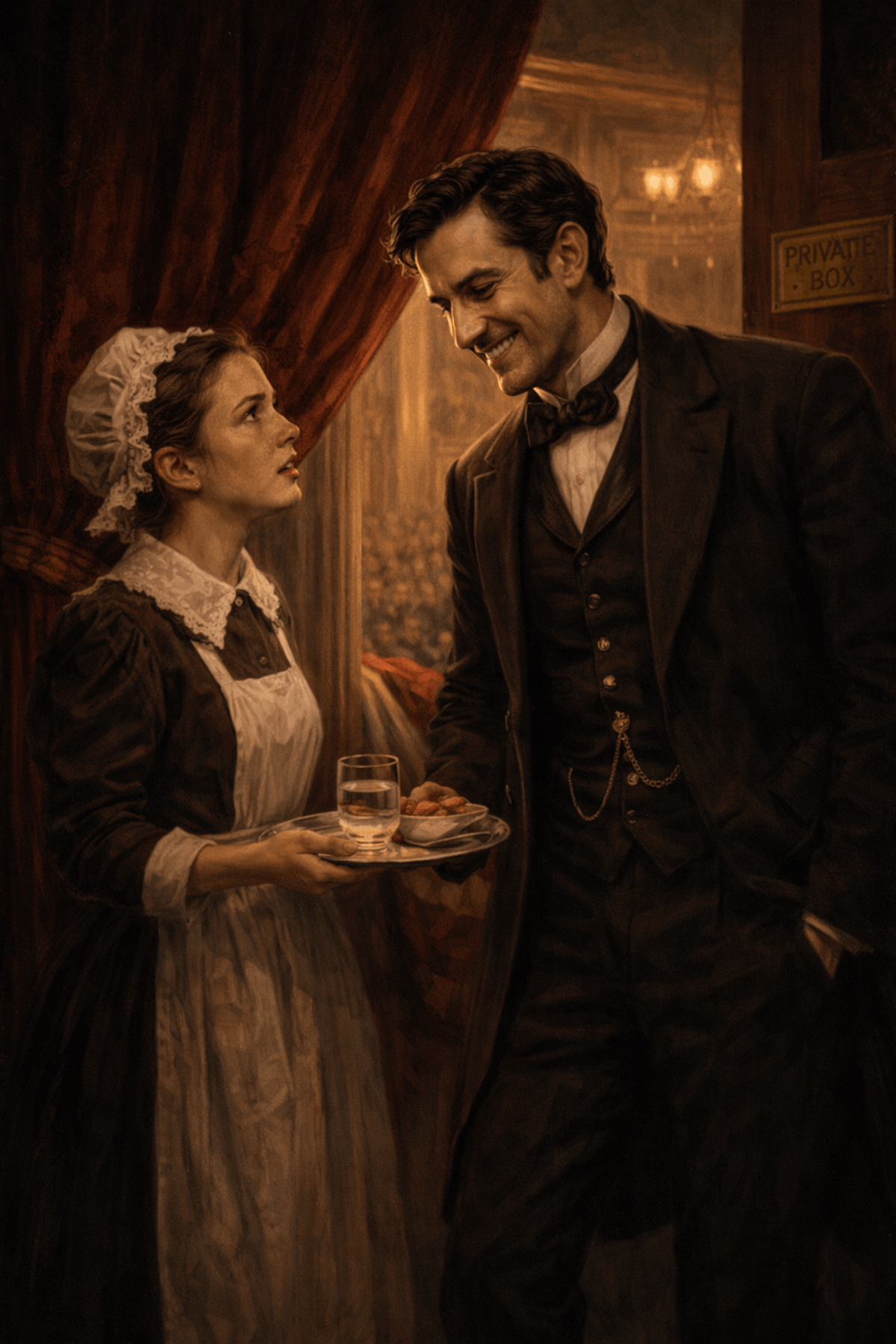
As John Wilkes Booth approached, a young woman emerged from the presidential box carrying an empty tray. She had just delivered refreshments to the distinguished guests. She recognized Booth immediately as he was, after all, a familiar and celebrated actor in Washington. She greeted him warmly. Their exchange was brief. One of the occupants had requested a stronger drink, and she was hurrying to oblige.
Booth smiled and tipped his head politely as she passed.
The corridor smelled faintly of perfume, cigar smoke, and damp wood. Beyond the door, Booth could hear the audience erupt in laughter. Harry Hawk, playing Asa Trenchard in Our American Cousin, was alone on stage, delivering one of the play’s most reliable comedic lines.
Booth withdrew his pocket watch.
10:15.
He knew the line by heart. “Don’t know the manners of good society, eh?” Hawk declared from the stage. “Well, I guess I know enough to turn you inside out, old gal—you sockdologizing old man-trap!”
The audience roared.
Perfect timing, Booth thought.
He stepped forward silently and entered the presidential box, his Philadelphia Derringer cocked and ready.