
Blog
A SPACE IN TIME – CHAPTER 6

There was sharp banging at the door.
Dr. Samuel Mudd woke with a start and reached for his pocket watch on the nightstand. He squinted at the face in the darkness. It was half past three in the morning.
“For God’s sake,” he muttered to himself.
He rose from the bed and dressed quickly, pulling on his trousers and boots. From the drawer beside the bed, he retrieved his revolver and tucked it into the back of his waistband. He doubted he would need it, but a man living as remotely as he did learned not to assume anything. Their farmhouse lay nearly twenty-five miles south of Washington, just outside Bryantown. Anyone arriving at that hour would have had to travel with purpose. The fact they were knocking rather than forcing entry suggested desperation, not malice.
The second round of knocking woke Sarah. She rose, wrapped herself in her robe, and followed him into the hallway.
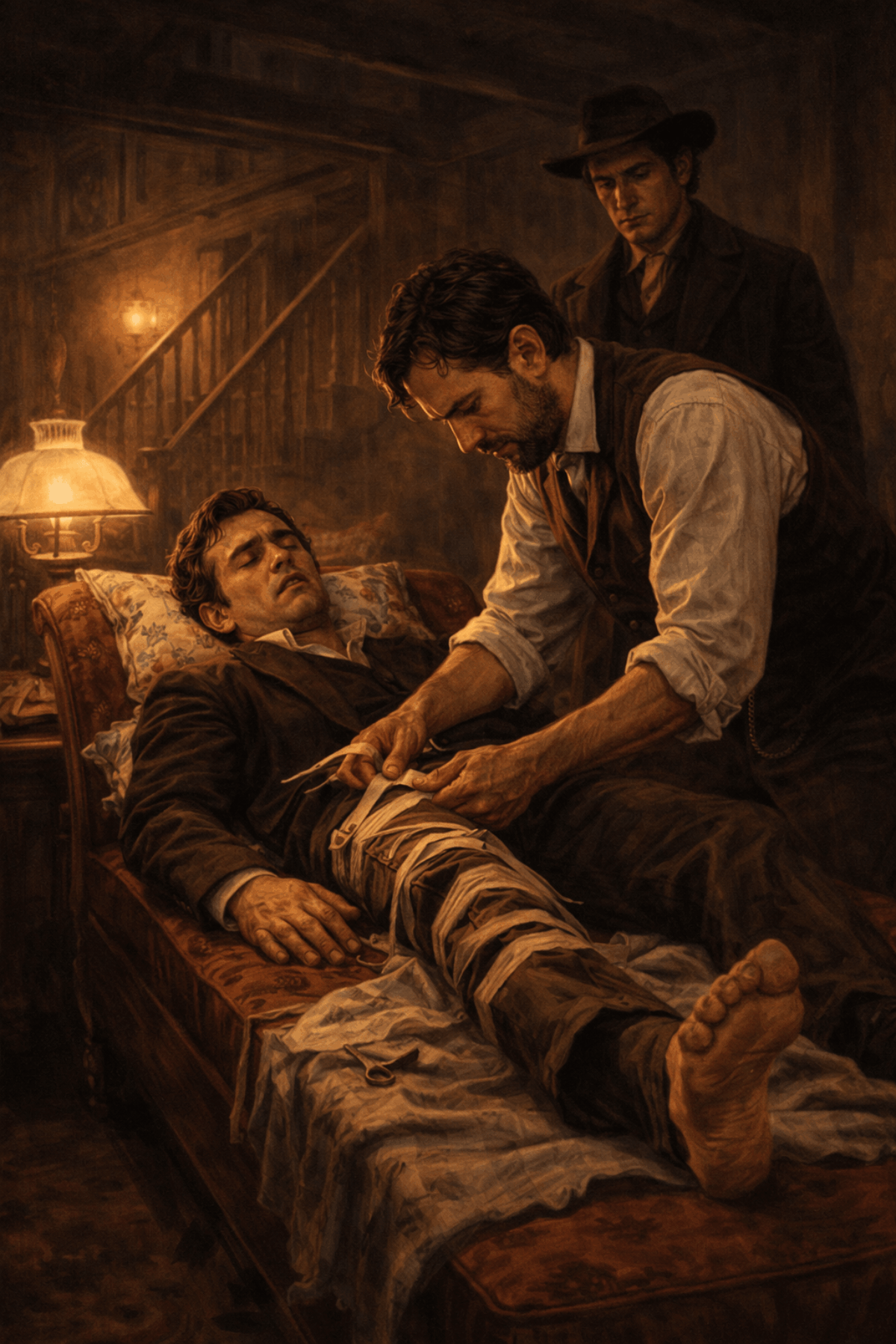
By the time she entered the foyer, Samuel had already opened the door and admitted two men. One supported the other, whose leg appeared badly injured. Samuel guided the wounded man toward the divan, which proved too small to accommodate his tall frame. The injured man grimaced in agony as Samuel began examining the leg.
“Sarah,” Samuel said calmly, though his voice carried urgency, “would you please fetch my medical bag from the office? This man has broken his leg and requires immediate attention.”
She obeyed at once, returning quickly with the worn leather bag she had seen him use countless times. As she handed it to him, she studied the injured man’s face. There was something familiar about him, though she could not immediately say why.
She left again and went to the kitchen to prepare coffee. It was what Samuel always wanted in moments such as this, and she suspected the injured man might benefit from it as well.
When she returned with the tray, she nearly dropped it.
Samuel had cut away the man’s boot. The bone had pierced the skin.
She had witnessed injuries before. Farm accidents, difficult births, and all manner of human suffering had passed through their home. Yet the sight of exposed bone unsettled her in a way she had not expected. Perhaps it was the hour. Perhaps it was the man himself. He was pale, drenched in sweat, and trembling uncontrollably.
Samuel spoke to the other man.
“How did this occur?”
The young man hesitated.
“His horse threw him,” he said at last. “Then stepped on him.”
Samuel did not respond immediately. He had treated enough broken bones to recognize patterns, and this injury did not resemble one caused by a horse’s hoof. Still, he had no desire to interrogate his patient.
Instead, he looked directly at him.
“Mr. Booth,” he said quietly.
The other man stiffened.
Booth opened his eyes and stared at him. Samuel met his gaze steadily.
“I must set the bone,” he said. “It will be painful.”
He reached into his bag and withdrew a small vial.
“This will ease it somewhat.”
He administered several drops of laudanum. Booth swallowed without protest.
Moments later, Samuel began.
Booth cried out as the doctor manipulated the shattered bone back into position. His cries echoed through the house, fading only when exhaustion overtook him. Samuel worked carefully, splinting the leg with wooden boards and wrapping it securely in bandages. When he finished, Booth lay trembling, his breathing shallow and uneven.
“Prepare the guest room,” Samuel said to Sarah.
She nodded and went upstairs at once.
Together, Samuel and the young man carried Booth upstairs and laid him gently upon the bed she had prepared. Booth was barely conscious now, emitting small involuntary sounds of pain. Within minutes, he fell into an uneasy sleep.
At breakfast, Sarah regarded her husband thoughtfully.
“You called him Booth,” she said.
Samuel nodded.
“Yes.”
She waited.
“He is an actor,” Samuel said. “John Wilkes Booth.”
She felt a chill as recognition came fully upon her.
“We saw him perform in New York,” Samuel continued. “At the Winter Garden Theatre. He appeared with his brothers, Edwin and Junius.”
She recalled the evening now. The grandeur of the theater, the thunderous applause, and the handsome young actor commanding the stage.
“What is he doing here?” she asked quietly.
Samuel did not answer immediately.
“I don’t know,” he said at last, though he suspected there was more to the story than had been told.
Booth awoke hours later in agony. The doctor had left to see to other patients.
Sarah hurried to Booth’s bedside.
“Please,” he whispered, his voice hoarse. “Laudanum.”
She gave him the last remaining portion. When it was gone, she offered him wine, the only other alcohol she had. Her and Samuel did not drink much, only for special occasions. Booth drank it gratefully, his hands trembling as he clutched the glass.
Gradually, the pain subsided enough for him to rest again.
Sarah remained nearby, watching him with growing unease.
David Herold moved quickly through the streets of Washington. Undetected, he made his way to the boarding house on H Street and knocked urgently. Mary Surratt admitted him without delay.
Inside, the others gathered.
Lewis Powell stood near the window. George Atzerodt sat rigidly at the table. John Surratt Jr. watched Herold intently.
Mary spoke first.
“Where is Mr. Booth?”
Herold hesitated. “He is alive,” he said. “But badly injured.”
Relief flickered briefly across their faces. Then Herold delivered the truth.
“Lincoln lives.”
The room fell silent. Powell stared downward, his expression hard and distant. Atzerodt’s hands trembled visibly. Mary’s face drained of color as the full weight of failure settled upon them.
“And Seward?” she asked.
“He lives also,” Herold replied.
No one spoke for several moments. Mary finally gathered herself.
“You must return to Booth,” she said. “He will know what must be done.”
Herold nodded.
He returned to the Mudd farmhouse before midday, carrying a bottle of whiskey. Sarah admitted him and directed him upstairs. Booth lay awake, his face pale and drawn. Herold handed him the bottle and told him everything.
Lincoln had survived. Booth listened in silence. His jaw tightened, and his eyes darkened with fury.
The pain in his leg was nothing compared to the rage building within him. Everything had been risked. Everything sacrificed. Yet Lincoln still lived. The Union won again.
With great effort, Booth sat upright. He would not accept failure.
He would decide what came next.