
Blog
A SPACE IN TIME – CHAPTER 7

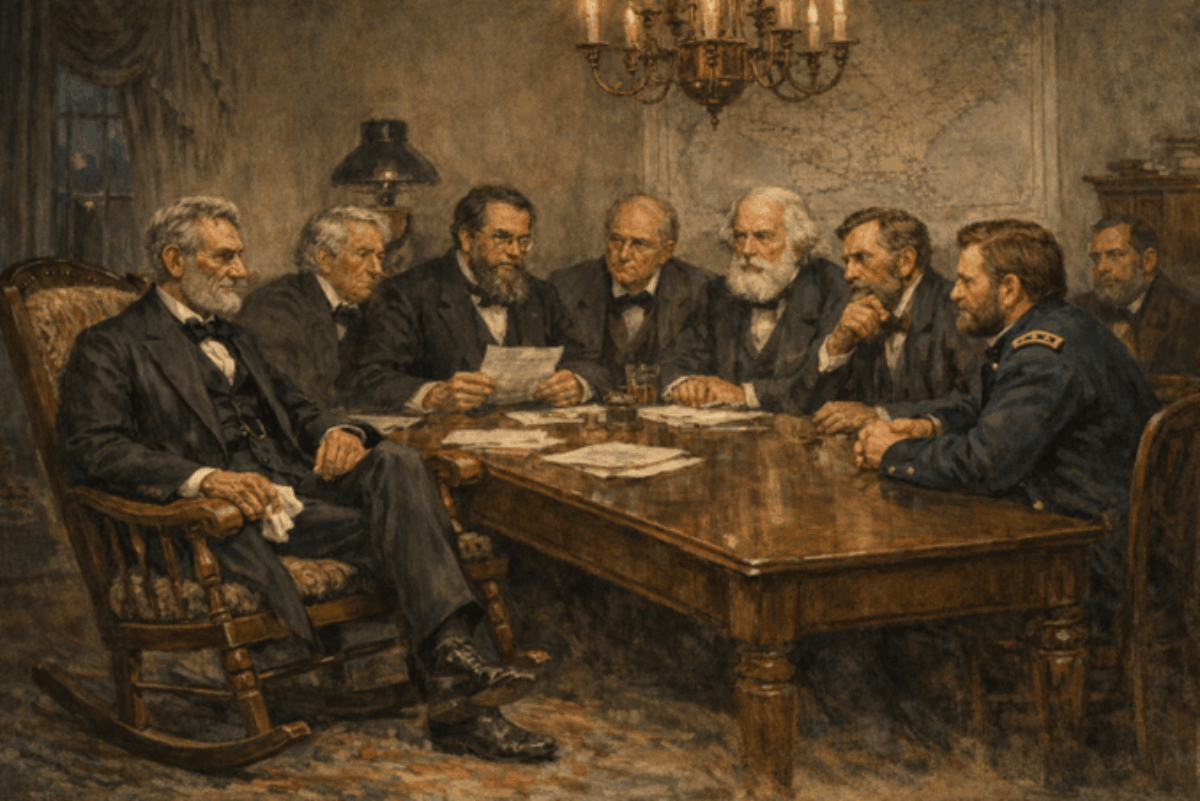
When Lincoln entered the Cabinet Room, every man rose to his feet.
Several began to applaud before they could restrain themselves. The sound filled the room awkwardly, born not of ceremony but of relief. Lincoln paused in the doorway, visibly uncomfortable with the attention. He had never cared for displays of admiration, and least of all for surviving something he believed he had never invited.
He raised his hand gently. The applause faded.
He crossed the room and settled into the rocking chair at the head of the table, the familiar motion calming him. He looked around at the faces before him; men who had carried the terrible burden of war alongside him.
“Good morning, gentlemen,” he began quietly. “It appears a man may only die once. I have merely postponed that inconvenience.”
A few nervous chuckles passed through the room. The men welcomed his composure, though none mistook it for indifference.
Secretary of War Edwin Stanton cleared his throat sharply, and the room fell silent at once. His expression was hard, his voice controlled but filled with restrained fury.
“Mr. President, last night’s attempt upon your life was not the act of a solitary madman. It was a coordinated conspiracy led by the actor John Wilkes Booth, a known Confederate sympathizer. Its object was nothing less than the destruction of this government.”
He paused, ensuring every man understood the gravity of his words.
“We have secured the city. Troops have been deployed at every major thoroughfare, and detectives have been dispatched throughout Washington and into Maryland. We will find Booth and every man who aided him. They will answer for their crimes.”
Lincoln listened without interruption, his face grave but composed.
Stanton continued.
“The conspiracy extended beyond yourself, sir. Vice President Johnson was also a target, though his assailant failed to act. Secretary Seward was not so fortunate. He was attacked in his home and severely wounded. He lives but remains confined to his bed.”
A shadow crossed Lincoln’s face.
“Gentlemen,” he said slowly, “it appears the Union has endured yet another injury. I should like to visit Mr. Seward when this meeting concludes. I would welcome your company.”
Stanton inclined his head.
“It would be my honor, Mr. President.”
Lincoln turned slightly.
“Have you any word of Booth’s accomplices?”
“We are pursuing several leads,” Stanton replied. “One man, David Herold, a known associate of Booth, was observed in the city this morning. He was lost in the crowds, but we are confident he remains within reach. His capture may lead us to Booth himself.”
At that moment, there was a knock at the door. Lieutenant General Ulysses S. Grant entered.
He removed his hat as he stepped inside, a cigar resting between his fingers rather than in his mouth, as though out of respect for the solemnity of the gathering. His uniform bore the dust of recent travel.
Lincoln’s face softened.
“General Grant, I am pleased to see you safely returned.”
Grant approached and saluted.
“Mr. President, I regret deeply that I was not present last evening. Had I known, I would not have left Washington.”
Stanton spoke.
“Lieutenant General Grant, we are grateful for your return.”
Grant nodded and took the seat Frederick Seward quietly offered him. The younger Seward moved to stand behind the others without protest.
Stanton resumed.
“Mr. President, we must insist upon additional protection. You will be guarded at all hours. Booth has already demonstrated both capability and intent. We cannot assume he will abandon his efforts.”
Several men nodded in agreement. Stanton hesitated before continuing.
“It is also the unanimous opinion of this Cabinet that you should take time to recover from this ordeal. The war has ended. The nation would understand.”
Lincoln rested his hands on the arms of his chair.
“I am grateful for your concern,” he said, “but the nation’s difficulties will not delay themselves out of courtesy to my discomfort.”
Before Stanton could respond, the door opened again.
Ward Hill Lamon entered.
His face was drawn, his eyes red. He crossed the room quickly and stopped before Lincoln, overcome with emotion.
“Mr. President,” he said hoarsely. “I should never have left you.”
Lincoln looked at him with quiet affection.
“Ward,” he said gently, “you have returned just in time to prevent me from being murdered a second time.”
The remark drew subdued laughter. The tension in the room eased slightly.
Lamon straightened and took his place beside Lincoln’s chair, where he remained. Lincoln rose slowly.
“Gentlemen, I will accept your counsel regarding additional protection, if only to relieve my wife’s anxieties. However, I do not intend to suspend my duties. We have endured too much to falter now. Mr. Stanton, I will expect regular updates on the progress of your investigation.”
“Yes, Mr. President.”
“I will be ready to visit with Mr. Seward in about half an hour, if you are so inclined, Mr. Stanton.”
“I shall be ready, sir,” Stanton replied.
Lincoln inclined his head to the assembled men and withdrew, Lamon close behind him. Outside the Cabinet Room, Nicolay rose at once.
Lincoln paused briefly in thé† the corridor, his expression thoughtful, but firm.
“Gentlemen,” Lincoln said quietly to Lamon and Nicolay, “this was no isolated act of a deranged man. It was a decapitation strike, intended to bring down the government in a single night. I have not merely survived an assassin, we have survived an attempted coup.”
He rested a hand lightly against the wall, as though steadying not himself, but the moment.
“The work of preserving the Union,” he said, “is not yet finished.”