

Blog
WE HOLD THESE TRUTHS TO BE SELF-EVIDENT

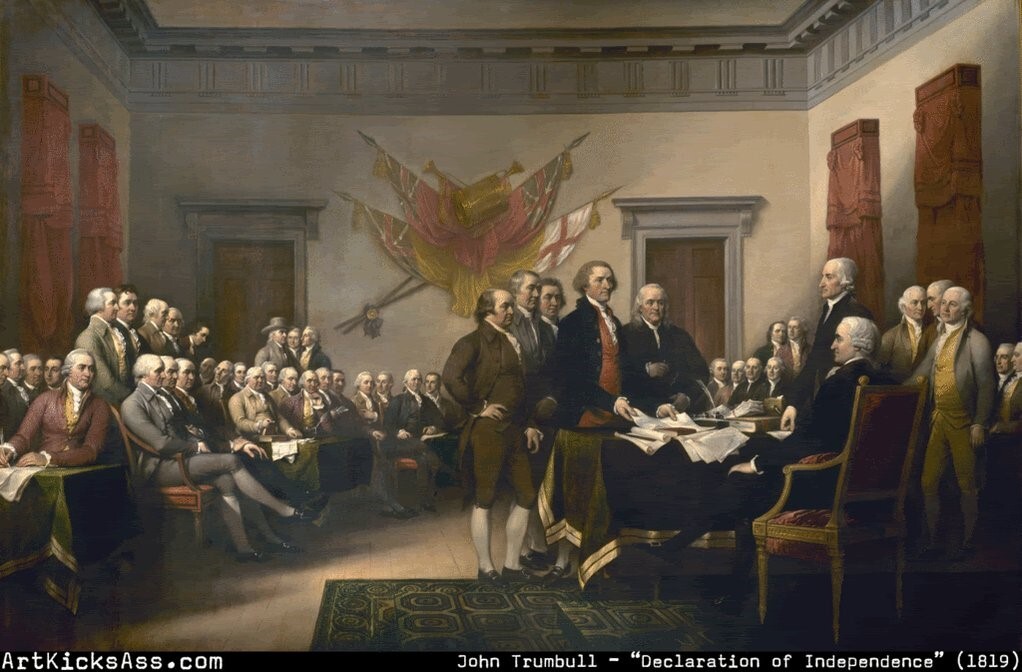
“When in the Course of human events, it becomes necessary for one people to dissolve the political bands which have connected them with another…”
July 4th is a week away. Happy Birthday, America.
Two hundred and fifty years ago, fifty-six men gathered in Philadelphia and signed what was effectively their own death warrants.
Had the Revolution failed, there would have been no sympathy, no appeals, and no second chances. Treason against the British Crown carried a simple penalty: the hangman’s rope.
They knew it. The British knew it.
Yet they signed anyway.
They were not superheroes. They were farmers, merchants, lawyers, doctors, and plantation owners. They had wives, children, businesses, and reputations. They had everything to lose.
And still they pledged to one another their lives, their fortunes, and their sacred honor.
Then they did something almost unimaginable.
They looked across the Atlantic Ocean at the most powerful empire on earth and told King George III they intended to govern themselves.
The odds of success were slim. The consequences of failure were enormous.
Fortunately for us, they won.
Today, 250 years later, we celebrate not only the nation they created, but the extraordinary courage it took to create it.
A few facts about the Declaration of Independence and America’s birthday may surprise you:
• Thomas Jefferson drafted most of the Declaration. He was only thirty-three years old.
• Two signers of the Declaration later became Presidents of the United States: Thomas Jefferson and John Adams.
• Five signers were captured by the British during the Revolution. We often remember that some of the signers risked their lives. Less remembered is that many lost far more than money.
- Francis Lewis watched the British capture his wife.
- John Hart lost his wife, his home, and months of his life hiding from British soldiers.
- Thomas McKean’s family spent years on the run.
Freedom wasn’t free. For some of the men who signed the Declaration, the price was paid not only in blood but in broken families, shattered fortunes, and personal heartbreak.
• The expression “Put your John Hancock here” comes from John Hancock’s famously large signature on the Declaration.
• John Adams and Thomas Jefferson both died on July 4, 1826—the fiftieth anniversary of the Declaration. They passed away within hours of each other.
• The Declaration is more than a statement of independence. It is a formal indictment containing twenty-seven grievances against King George III.
• More than twenty percent of Americans remained loyal to Britain during the Revolution, including Benjamin Franklin’s own son, William Franklin. The split between father and son became permanent.
Now consider the world in which the Declaration was signed:
• Napoleon Bonaparte was seven years old.
• Mozart was twenty.
• There were no automobiles, telephones, radios, airplanes, computers, or antibiotics.
• Photography did not exist.
• Baseball hadn’t been thought of.
• Electricity was little more than a scientific curiosity.
• Most Americans used outhouses.
• Travel was measured in days and weeks, not hours.
And yet, in that world, a handful of men produced ideas that still shape the lives of hundreds of millions of people.
That may be the most remarkable fact of all.
The Declaration of Independence and the Constitution were not technological achievements. They were intellectual and philosophical achievements.
While much of the world remained governed by kings, emperors, and inherited privilege, these men proposed something radical:
That rights come from God, not government.
That legitimate government derives its authority from the consent of the governed.
That ordinary citizens are capable of governing themselves.
Whether one sees divine guidance, extraordinary human intellect, or a combination of both, what emerged from Philadelphia became one of the most consequential political experiments in human history.
And perhaps that is why we are still debating those ideas 250 years later.
Empires have risen and fallen. Kings have come and gone. Nations have disappeared.
Yet Americans still argue over words written by men in powdered wigs, working in sweltering rooms, traveling by horseback, and writing by candlelight.
Not because those words are old.
But because they still matter.
Happy 250th Birthday, America.